



Compliance with environmental legislation: SEPREMIUM’s solution for air compressor condensate management
Compressed air systems generated by lubricated compressors produce condensates which, if not properly treated, can become a real environmental hazard. These condensates, mainly composed of non-biodegradable oil, can seriously contaminate flora and fauna. In some cases, oil concentrations reach alarming levels, up to 10,000 mg/l. Faced with this situation, the question arises: how can these condensates be treated effectively, while complying with environmental regulations?
A strict legislative framework to protect the environment
The management of compressed air condensates is governed by three main pieces of legislation
- The French Water Act of January 3, 1992,
- The decree of March 29, 1993,
- And the decree of March 1, 1993.
These regulations aim to protect water resources and aquatic ecosystems by imposing strict technical standards for the discharge of industrial wastewater. In particular, they prohibit the direct discharge of untreated condensates into sewers, in order to limit the dispersion of hazardous chemicals and hydrocarbons.
But what exactly is a condensate?
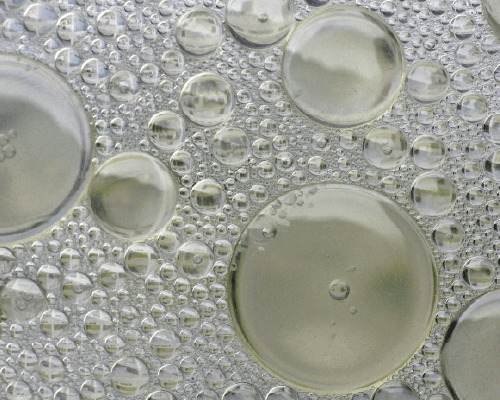
Condensate: a hazardous industrial waste
When air is compressed, a by-product is generated: condensate. This is a mixture of water, oil, particles and hydrocarbons. Although 95% of this mixture is water, the presence of hydrocarbons and chemicals makes it a hazardous industrial waste.
This makes oil-water separation essential. Not only is it an ecological necessity, it’s also a cost-effective solution, since the volume of waste to be disposed of has a direct impact on disposal costs. Companies must also comply with the requirements of ISO 14000, which imposes rigorous management of industrial waste.
So what are the rejection limits?
Precise discharge limits to be respected
Regulations set strict limit values for hydrocarbon content in wastewater discharges:
- 10 mg/l for classified facilities, when discharge exceeds 100 grams per day,
- 20 mg/l for other installations.
These values may vary depending on the company’s location and the requirements of local authorities (DDASS, basin agencies, municipalities). Failure to comply with these standards may result in severe penalties and compromise the company’s environmental compliance.
So what solutions are there to remove this condensate?
The limits of traditional solutions
Traditionally, condensate removal is based on two methods:
- Periodic transport of condensates by a specialist company. However, this solution is costly and involves risks associated with on-site storage.
- Gravity decanters, which separate oil from water. However, this method has become obsolete with the evolution of modern lubricants, whose density is close to that of water, forming an emulsion that is difficult to separate.
Faced with these limitations, an innovative solution was needed: SEPREMIUM.

SEPREMIUM: Advanced technology for water/oil separation
To overcome the challenges of condensate removal, MAC3 offers SEPREMIUM technology. Unlike traditional systems, SEPREMIUM uses polypropylene filter elements and an activated carbon filter to effectively separate oil from water.
The advantages are numerous:
- No storage tank or settling chamber,
- Simplified compliance with environmental regulations,
- Sturdiness and ease of maintenance thanks to its molded polyethylene design and brass threaded inserts.
- Filter elements guarantee maximum efficiency, even in difficult conditions where other systems fail.
By adopting SEPREMIUM technology, companies can :
- Reduce condensate disposal costs,
- Guarantee their compliance with ISO 14000,
- Get rid of obsolete and costly methods.
This reliable, high-performance solution protects the environment while optimizing costs.
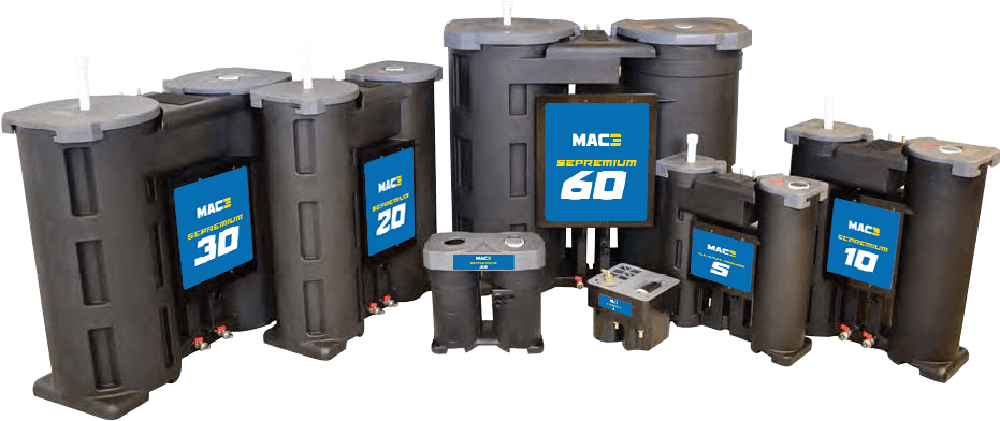
Compressed air condensate management is a major issue for companies concerned with environmental compliance. Traditional solutions are no longer adapted to today’s challenges. Adopting modern technology such as SEPREMIUM is now essential to ensure effective separation of oil and water, while reducing health and environmental risks.
For companies using air compressors, investing in a standard-compliant condensate treatment system is both a legislative imperative and a sustainable strategy for protecting the planet and controlling costs.